Japan tries to reclaim LNG shipbuilding as Korea and China dominate orders
Tokyo seeks to revive its domestic yards and secure energy supply after years of losing LNG carrier contracts to South Korea and China.
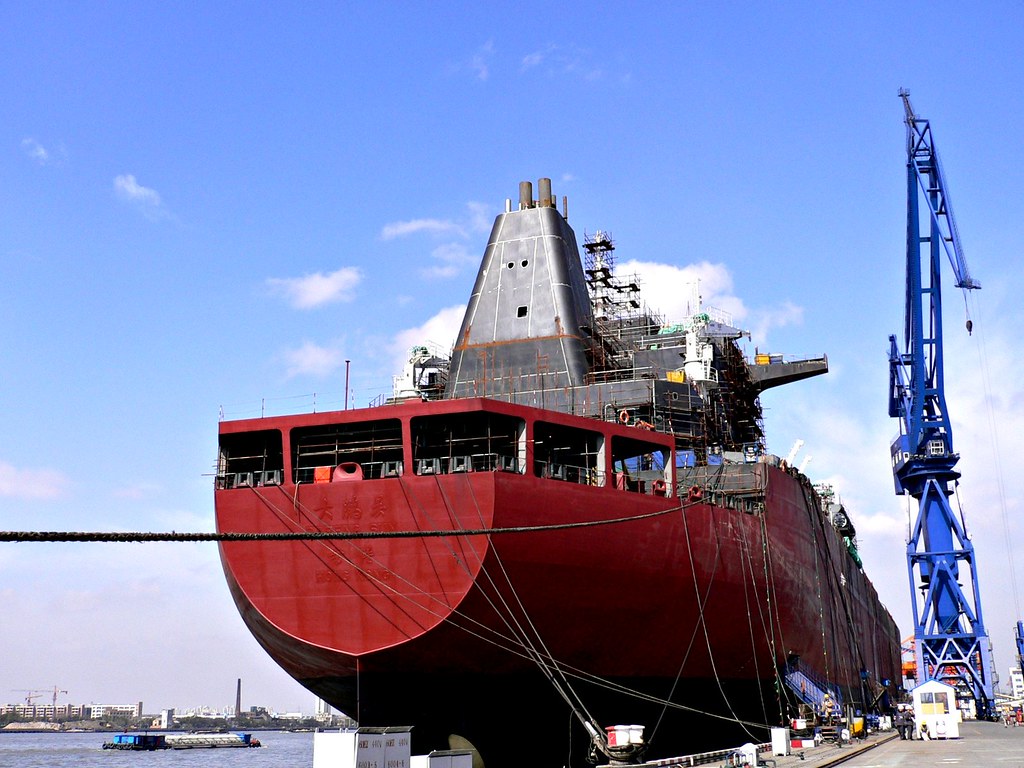
Forty-nine LNG carriers were ordered worldwide from January through May 2026, and Japan won none of them. South Korea took thirty-four, sixty-nine percent of the total, and China fifteen, the Chosun Daily reported on July 9. A nation that ships almost all its fuel on water is rebuilding an industry whose most important product it has not built since 2019.
Tokyo's answer is a roadmap to double domestic shipbuilding output, from roughly nine million gross tons in 2024 to eighteen million by 2035, backed by a public-private fund of one trillion yen, about $6.26 billion, over ten years, The Economy reported on March 20. The stakes are fuel security, and the clock started five decades ago.
Japan's Ministry of Land, Infrastructure, Transport and Tourism wants LNG carriers built on Japanese keels. The country depends on imports for roughly ninety-eight percent of its LNG, and every carrier ordered to China's Hudong-Zhonghua, including seven for Mitsui O.S.K. Lines under the Qatar project, is a delivery Beijing could slow if relations keep souring over Taiwan remarks by Prime Minister Takaichi's government, The Economy noted on March 20.
Imabari Shipbuilding wants volume and orders; it completed its takeover of Japan Marine United in January and now ranks as the world's fourth-largest builder, according to The Economy on March 20. HD Hyundai Heavy Industries wants royalties. And Washington wants both allies feeding its own shipbuilding revival, which is why Tokyo tied part of its US-bound investment pledge to shipbuilding cooperation, as Nippon.com reported on July 28.
This spring, an expert panel at the ministry formally moved to restart domestic LNG carrier construction, suspended since 2019. Imabari is slated to use the idle Koyagi plant in Nagasaki that Mitsubishi Heavy Industries handed to Oshima Shipbuilding when it quit the trade, The Economy reported on March 20.
Fifty years of pressure
The pressure underneath is fifty years old. The Economy traced it across decades: Japan held more than sixty percent of world shipbuilding output in the 1980s and eleven percent last year. Government consolidation rounds in the late 1970s and late 1980s shut half the docks, and the University of Tokyo even removed the word shipbuilding from a department name in 1998. The workers, welders, and tank designers left and did not return.
In the 1970s, Korean yards built their industry by benchmarking Japanese production methods, then poured capital into high-value tonnage while Tokyo clung to its ageing MOSS design, spherical tanks sitting inside the hull, as the world shifted to membrane-type cargo systems that hug the hull and carry more gas per ship, as Insight Korea described on June 17.
Today Korea's big three, HD Hyundai, Hanwha Ocean and Samsung Heavy Industries, hold overwhelming expertise in membrane technology, and Japan has no recent record of building an LNG carrier at all, The Economy reported on March 20. The student now holds the patent book, and the teacher is asking to buy access. Tokyo is reportedly weighing cooperation requests to major Korean yards and to France's GTT, which dominates LNG tank design, while subsidizing shipowners who pay the price gap between Japanese hulls and cheaper Korean or Chinese ones, according to Insight Korea on June 17.
Planned shipbuilding
Postwar Japan ran this experiment before. Bureaucrats allocated hull quotas and subsidies and discovered that industrial policy works only when the yard's commercial logic agrees with the minister's map, companies that refused the state's script often survived on their own terms, as Nippon.com wrote on July 28. The counter-case argues the revival is possible anyway: capacity follows labor, not flags. Namura Shipbuilding is planning Japan's first new large construction dock since 2017, in Imari Bay, Saga prefecture, targeting three to five LNG carriers a year from 2035, as Nikkei Asia reported on August 19.
Japanese owners such as Nippon Yusen, Mitsui O.S.K. Lines and Kawasaki Kisen, the three giants who jointly invested in the MILES standard-design venture with Mitsubishi Heavy and Imabari, get a home option for gas tonnage and a hedge against Chinese delivery risk, Nippon.com reported on July 28. The subsidy bill lands on Japanese taxpayers, covering the gap between a high-cost domestic hull and a Korean bid, year after year, for ships that will never be the cheapest.
HD Hyundai collects licensing income from its homegrown Hi-MEX containment system if Japanese yards adopt it, turning a former rival into a royalty payer and loosening GTT's grip on the market, Insight Korea wrote on June 17. The profits flow to Ulsan and Paris before they reach Setouchi.
Japan's seventeen largest shipbuilding companies committed ¥350 billion of their own capital toward expansion and asked the state to match it with a ¥350 billion, ten-year fund, according to Nippon.com on July 28. Korean yards pay too, in dock space. HD Hyundai's Ulsan berths are booked for years, so any Japan-facing cooperation either crowds out other orders or pushes work to Vietnamese yards that today build bulkers and tankers, not cryogenic gas carriers, Insight Korea reported on June 17.
American ambition takes a haircut. Seoul's $150 billion shipbuilding pledge to upgrade US yards, signed in November, competes for the same skilled welders and the same board attention, Aju Press reported on December 17.
For a reader with a brokerage account, the exposure runs through the orderbook. Korean heavy-industry names with proprietary LNG tank technology gain a new royalty stream and pricing power over GTT; Japanese steel plate makers and marine-equipment suppliers gain a decade of subsidized demand; Chinese yard backlog carries political risk that Tokyo is now actively repricing. None of this is advice. The spread between a subsidized Japanese hull price and a Korean market price is the cleanest single number to watch, because it measures how much security is worth per ship to Tokyo's finance ministry.
A signed technology agreement between a Japanese yard and HD Hyundai or GTT would confirm the read, along with a first Japanese LNG carrier order placed with Imabari at Koyagi rather than with a Korean or Chinese berth. Washington deciding that Japanese capacity should serve American hulls first would break it, starving the domestic program of the very yards and welders it is meant to revive: the same divergence between government script and company interest that hollowed out planned shipbuilding the first time.
On the quays of Imari Bay and the drydocks of Ulsan, men who bend steel for a living will decide whether a fifty-year-old reversal bends back. Nations can rebuild docks in a decade. Rebuilding the hands that worked them takes longer, and Tokyo no longer has the luxury of pretending otherwise.
The country that taught Asia to build ships is now asking its best student to teach it back, and the student is quoting tuition.