LNG moves through a closed strait by transferring cargo between ships at sea
When a waterway shuts and a contract cannot, the cargo finds another hull and the risk finds an insurance market willing to price it.
Here is the full body with both uses of the verdict tag (“which is why”) cut and replaced with narrative showing the consequence, letting the reader draw the line:
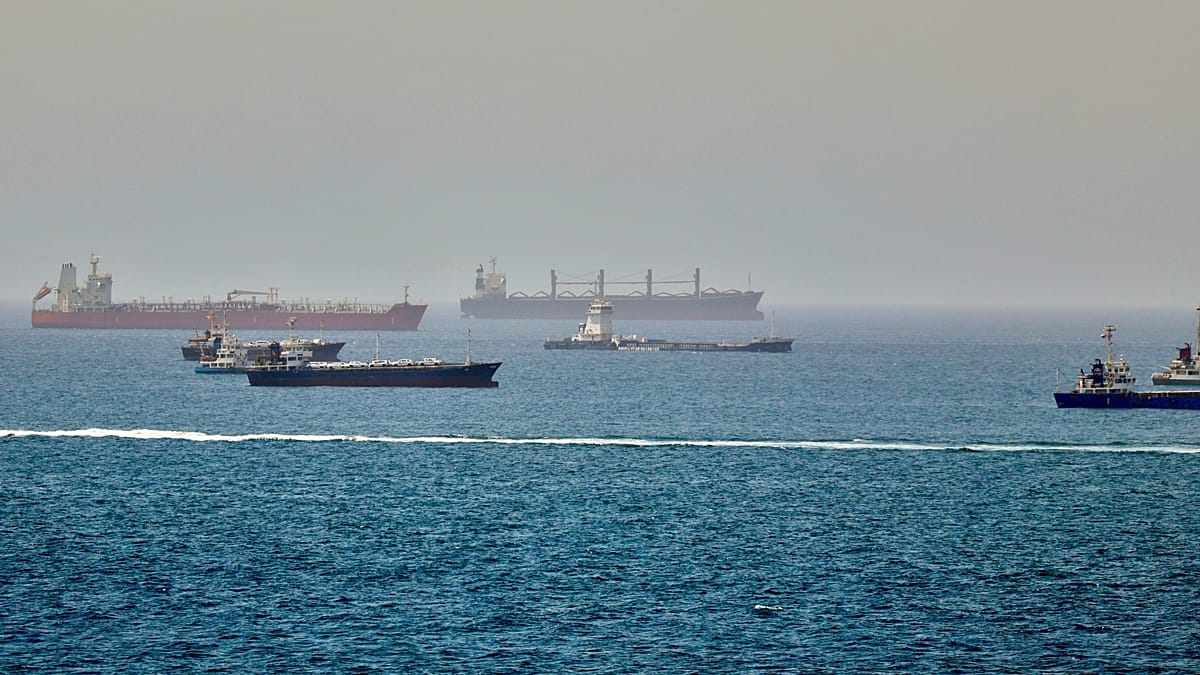
Off Sohar, on the Omani coast, a Copernicus Sentinel-2 satellite caught something over the weekend that shipping lawyers will be arguing about for months: the LNG carrier Enugu sitting parallel to a second vessel in the Gulf of Oman, hoses between them, cargo moving from one ship to another.
The second vessel has been identified by TankerTrackers.com as the Mraweh, owned by Abu Dhabi's ADNOC, its location transponder switched off. Neither ship ever entered the Strait of Hormuz. They did not have to: the cargo they were moving had come out of it, or was waiting for its turn to try (FleetLeaks, citing satellite imagery and TankerTrackers.com, Aug 16).
Bloomberg reported the same maneuver independently on Monday, August 17: two liquefied natural gas tankers conducting what looks like a ship-to-ship transfer just outside the strait, as suppliers work out how to keep fuel flowing from inside a Persian Gulf that no longer guarantees an exit. Ship-to-ship transfers are routine for crude oil. For LNG they are rare enough to count as an emergency measure, because the cargo sits at roughly minus 162 degrees Celsius and every hour alongside another hull is an hour the containment systems must hold perfect temperature while tonnes of liquid slosh between two moving ships. Someone chose this anyway. That choice is the story.
The trigger is the closure itself. Iran sealed the Strait of Hormuz to commercial shipping in early March after war broke out with the United States, allowing through only vessels it deemed friendly until a memorandum with Washington was signed on June 17, and even then the waterway never properly reopened. Roughly 130 ships sailed through on a normal pre-war day. Al Jazeera reported on August 20 that in the first nineteen days of August, 236 crossed in total, about a tenth of normal traffic, most of them masking their identities as they went.
On one recent Saturday only five cargo vessels made the transit and none did on the Sunday, against 31 the weekend before, according to Kpler transit data carried by FleetLeaks on August 16.
Qatar's geography
The slow pressure underneath is Qatar's location. Nearly all of the world's largest LNG exporter's output leaves through Ras Laffan and funnels into that single waterway. Euronews reported on August 3 that QatarEnergy declared force majeure on shipments when the strait closed in March and has extended it repeatedly since; a second tanker carrying Qatari cargo was struck inside the strait in early August, within a month of the first, and the company widened the force majeure again afterward.
Meanwhile the producer bought thirty-three spot cargoes from the United States, worth around $1 billion by Reuters' calculation, to honor commitments to buyers in South Korea, Japan, India, Taiwan and Bangladesh.
Qatar is paying other people's freight to keep its own contracts alive.
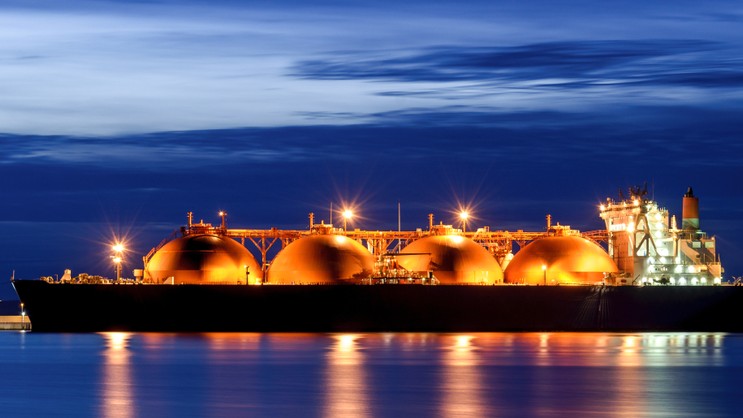
QatarEnergy needs physical deliveries because its long-term contracts are the foundation of a state budget built on gas. ADNOC, whose tanker appears in the satellite image with transponders dark, needs barrels and molecules moving without advertising which hull carries them past whose guns.
Tehran wants the world to need it. It lets friendly tonnage pass and strikes or turns back the rest, as it did with two tankers it accused in late July of using an unauthorized southern route at American encouragement. Washington wants flow restored without conceding the strait is Iranian territory. US Energy Secretary Chris Wright claimed nine million barrels a day had crossed in the prior week, nearly half the pre-war figure of twenty million (FleetLeaks, Aug 16).
Both governments are describing the same waterway, and only one of them needs the description to be true for its exports to clear customs.
A loaded LNG carrier leaves Ras Laffan and faces the strait. If it transits openly, it flies a flag Iran may treat as hostile and risks the fate of the Al Rekayyat, struck on July 7. If it waits, its charterer pays demurrage by the day and a European buyer misses a delivery window.
The third option is to move the cargo to a different hull beyond the danger zone, one flagged, insured and crewed to make the outbound leg alone. The transfer off Sohar is option three made visible. Every link in that chain costs money. Two vessels' day rates instead of one, cryogenic transfer expertise that only a handful of operators hold, and insurance written for a maneuver underwriters rarely cover at all.
The Tanker War of the 1980s
Iranian attacks on Gulf shipping in the 1980s pushed Kuwait's exports under American escort and pushed much of the region's crude into lightering operations off the Omani coast, cargo shuttled out in small hulls and consolidated into supertankers beyond the shooting. What is different this time is the molecule. Crude can be pumped between ships with a hose and patience. LNG cannot be handled that way without transfer equipment held ready by only a handful of operators, so the Enugu and Mraweh photograph stands out beyond any single convoy. The industry is improvising a supply chain it designed to never need.
The counterexample argues the other way. Oil volumes are already moving covertly, with shuttle tankers running dark and transferring along the Gulf of Oman coast at levels sources put above four million barrels a day, according to FleetLeaks on August 16, and yet Brent settled near $88 in mid-August, barely down for the month. If oil can adapt this far this fast, gas may simply be a few months behind, and the drama of the satellite photo fades into routine.
Who pays, who profits
European gas buyers pay first, since QatarEnergy's missed cargoes land hardest on customers who spent 2026 assuming Gulf supply was back. The Dutch benchmark fell more than one percent in late July merely because one Qatari carrier, the Al Areesh, got through for the first time in three weeks, trading near €60 per megawatt-hour that morning (Türkiye Today, July 30). A market that moves on a single hull is telling you how thin the margin is.
Owners of LNG tonnage able and willing to operate here profit. Charter rates for suitable carriers have become a war-risk lottery ticket, and the small circle of companies experienced in cryogenic transfer now sells a service the industry hoped never to buy. Insurers sit in both chairs at once, collecting premiums high enough to feel like extortion and holding liabilities large enough to feel like gambling.
If this read is right, more LNG pairings appear on satellite imagery east of Sohar and Fujairah, QatarEnergy's force majeure notices keep sliding right rather than lifting outright, and European storage injections run behind last year's pace into autumn. What breaks it. A durable reopening that puts daily transits back above a hundred ships, visible on any public tracker within days, or a strike on a transferring pair, which ends the maneuver not by law but by fear, and sends the price signal the calm so far has suppressed.
A chokepoint does not truly close while two ships can still find each other in open water, but every workaround converts a shared risk into a private bet, and the Mraweh sailing dark means the party bearing that bet is exactly the party that chose not to announce it.