Suspected drone strike on Greek tanker widens the Black Sea shipping war
The drones stopped aiming at warships, and now the ships carrying American crude money, Kazakh barrels and Turkish grain are the ones burning.
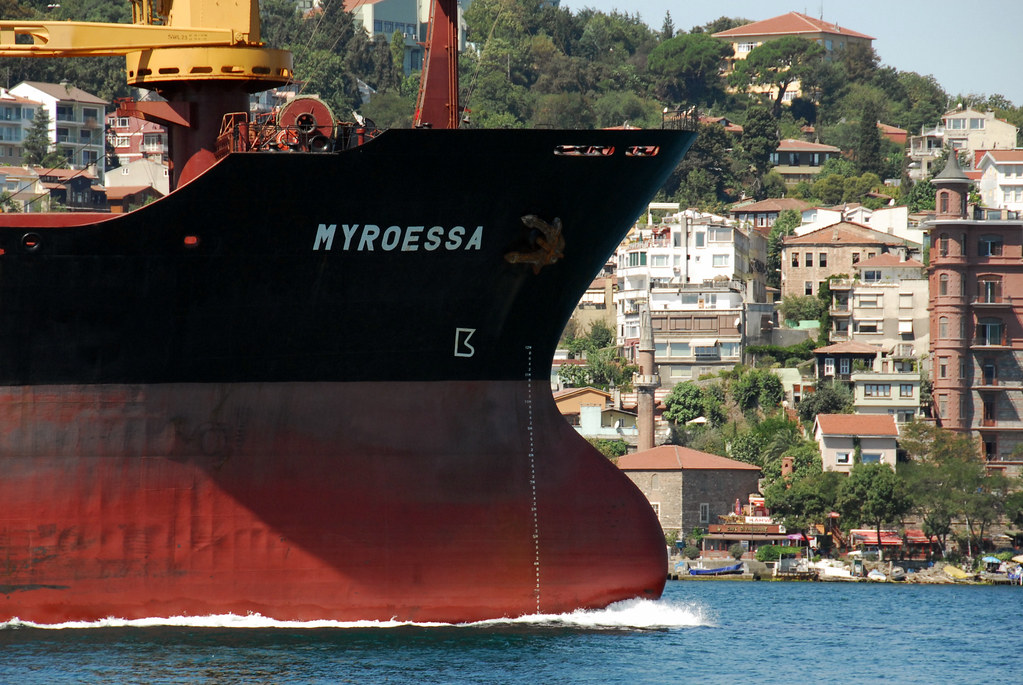
At mooring SPM-3 off Novorossiysk, the Nissos Sifnos was mid-load, Tengizchevroil crude running through her cargo manifolds, when a drone hit the Marshall Islands-flagged suezmax on July 30. Six nautical miles away, the Dynacom-operated Marathi, waiting for her berth, took two projectiles.
The Caspian Pipeline Consortium stopped every loading after the strikes, The Times of Central Asia reported on August 3. Two days before them, Secretary of State Marco Rubio and Kazakh Foreign Minister Yermek Kosherbayev had talked on a call about keeping exports through that same terminal "reliable and uninterrupted," according to the same report. The Greek owners of the tankers and the American diplomats guaranteeing the oil are all working a sea where each loading berth doubles as a firing range, and Washington's word to Astana cannot outlive the next drone.
Strikes and rising risk
Lloyd's List framed the strike in August 2026 as suspected Ukrainian work landing despite a reported Black Sea deconfliction arrangement, and noted it risks pulling more nations into the shipping war. Ukraine's drone forces did claim four Russian-linked tankers struck overnight in the Black and Azov seas, though without naming vessels or locations, so responsibility for Nissos Sifnos remains unproven, The Times of Central Asia reported on August 3. What is proven is the pattern. At least eight tankers were hit at or near the CPC terminal during July alone, starting with the Chevron (CVX)-chartered Yasa Polaris on July 7, per the same report of August 3.
Ukraine wants Russian export revenue strangled, and hitting the ships that carry Russian-processed Kazakh crude hurts Moscow's port revenues and its refinery feedstock in one blow.
Russia wants Ukrainian grain off the water and Kyiv's ports dark, which is why its strikes have moved onto civilian hulls.
Greece owns the largest merchant fleet touching these waters and profits from every voyage, so Greek owners like Okeanis are now absorbing risk priced by someone else's war. Kazakhstan and its Western partners want their barrels moving and their names out of the crossfire: Chevron holds 15 percent of CPC and half of Tengizchevroil, ExxonMobil (XOM) 7.5 percent of the pipeline and a quarter of Tengizchevroil, The Times of Central Asia reported on August 3. Nobody at the terminal picked this fight; everyone at the terminal is paying for it.
Old pressures, new targets
The trigger was one drone at 1:48 a.m. Moscow time. The pressure underneath is older. Since early July both states have treated merchant shipping as a legitimate target, and Ukraine's infrastructure ministry counted 52 civilian vessels attacked by Russia in July and the first half of August, according to gCaptain on August 21. That ministry puts the war-long toll of people killed and injured in such attacks at 329 in the same account. Once each side concluded that the other's economy, not just its navy, was the target, every neutral hull between Odessa and Novorossiysk became part of the battlefield whether its flag agreed or not.
The Tanker War
The Tanker War of the 1980s offers one close model. Iran and Iraq spent eight years shooting at each other's oil shipments and, mostly, at neutral tonnage in the Gulf, until the United States reflagged Kuwaiti tankers under the Stars and Stripes and put its own navy behind them. A great power accepting direct exposure so commercial crews would not carry the risk alone was what ended it. The difference this time is that the United States is arming one belligerent, not patrolling against both, and no escort scheme exists for the Novorossiysk moorings.
The counter-example cuts the other way. In the Gulf, traffic never actually stopped; premiums rose, crews sailed anyway, and roughly two hundred merchant sailors died across eight years without either economy breaking. Shipowners have absorbed worse than this and kept trading. But the Black Sea version compresses the same dynamic into weeks instead of years, and the damage lands faster because the choke points are single pieces of steel: one pipeline, five offshore moorings, three grain quays.
When the July attacks repeatedly stopped loadings, CPC had to stop taking crude, storage filled, and producers upstream were forced to shut in wells within days, The Times of Central Asia reported on August 3. On July 22 Kazakhstan's oil and gas condensate output fell 21 percent to 1.63 million barrels per day, Tengiz production dropped about 56 percent, and by July 26 national output sat near one million barrels per day against a June average of 2.16 million, The Times of Central Asia reported on August 3.
Who pays
The same logic runs through grain. More than 97 percent of Russian and Ukrainian grain export capacity in the Azov-Black Sea basin has been shut down by the attacks, with Russia's KSK and Taman terminals suspended and the Odesa hub effectively idle since late July, gCaptain reported on August 19. Ukraine offered Russia a Black Sea truce as its own grain exports fell 76 percent year-on-year in August, Reuters via Yahoo News reported in August 2026.
First come the seafarers: nine crew and a pilot killed when the Golden Leo sank leaving Chornomorsk with corn aboard on July 19, a captain lost on the Atlas Bey the day before, as gCaptain recounted on August 21. Second the owners and insurers, whose Joint War Committee listed areas were redrawn as recently as JWLA-034 on July 29, pushing war-risk premiums up on every hull entering these waters.
Third the shareholders of Chevron (CVX) and ExxonMobil (XOM), who eat the deferred cargoes and shut-in production. Last, the consumer, through grain prices. Who profits. Tramp owners outside the war zone whose rates rise on everyone else's danger, and whoever sells Moscow and Kyiv the drones.
Romania's entry shows where this goes next. On August 20 Romanian F-16s destroyed an explosive marine drone approaching the Neptun Deep gas platform in Romania's economic zone, where several hundred workers were on the platform; Ukraine denied ownership and Romania's president blamed Russia, Reuters reported through Euronews that day. A drone aimed at European Union energy infrastructure is one misjudged turn away from forcing a NATO country to invoke consultation over an attack on its own territory. The war at sea keeps expanding precisely because neither side can win on land quickly enough to matter.
CPC loadings resume under heavier naval cover but at reduced tempo, war-risk premia for Novorossiysk calls stay elevated into autumn, and another state-flagged or NATO-adjacent vessel is struck before October, dragging a third government formally into the dispute. If instead a durable deconfliction deal takes hold and loadings run uninterrupted for a month, the read breaks and the July escalation was a spike, not a regime.
The consequence lives with Filipino and Turkish deckhands extinguishing fires on ships they chartered nothing of, and with Greek families like the Alafouzos interests behind Okeanis deciding each morning whether a charter to Novorossiysk is still worth the wire transfer.
Wars that make their living from other people's cargo do not end when one side tires; they end when the neutral carriers refuse the trade. The Black Sea is one refused charter away from finding out which side blinks first.