Memory makers shift wafer supply to HBM, pushing up DDR5 prices
As Samsung, SK hynix (SKHY) and Micron favor high-bandwidth memory for AI servers, retail buyers are left paying drastically higher prices for conventional DRAM.

A DDR5 module on a German price list now sells for nearly five times what it did fourteen months ago, according to wccftech's late-August survey of retail memory in August 2026.
Nothing about that stick changed, same capacity, same factory processes. What changed is who gets the silicon underneath it, and the answer, increasingly, is the data center down the highway.
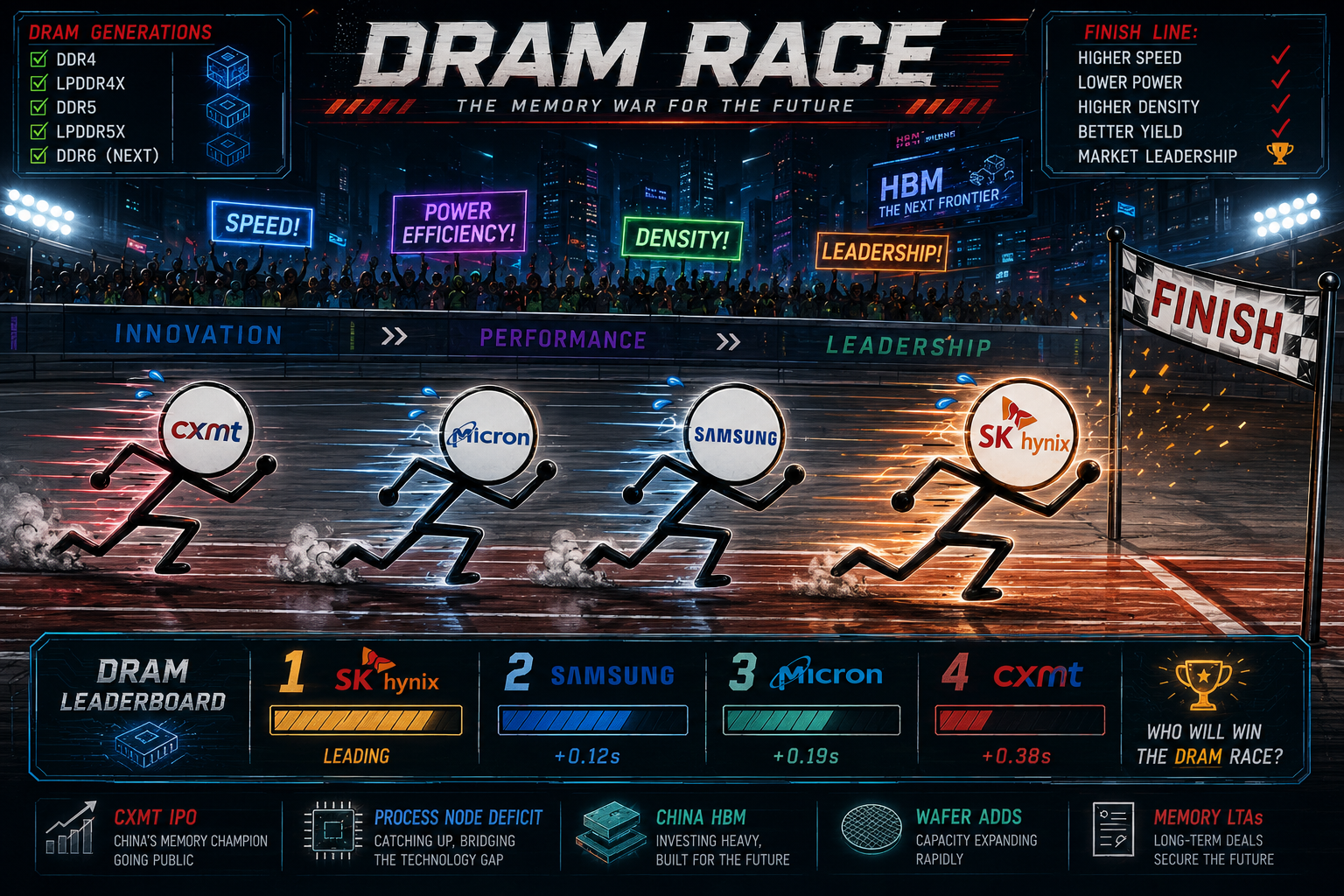
Three companies make nearly all the world's DRAM: Samsung Electronics, SK hynix and Micron Technology (MU). All three have spent 2026 steering their most advanced wafer capacity toward high-bandwidth memory, the stacked DRAM that sits beside Nvidia's (NVDA) accelerators, because AI buyers pay more per bit and sign contracts that run for years. The wafer a fab gives to HBM is a wafer that never becomes a memory stick. This piece traces where that tradeoff lands, who agreed to it before it arrived, and who is now absorbing it without a contract of their own.
The price evidence is not subtle. TrendForce forecast on January 5, 2026 that conventional DRAM contract prices would rise 55 to 60 percent in the first quarter as suppliers moved advanced nodes toward server and HBM products, and Tom's Hardware reported on Micron's Hot Chips presentation in August 2026 that the actual reading came in worse, with contract prices up roughly 90 to 95 percent quarter over quarter. Electronic Component News, in its DRAM market roundup in August 2026, put the second quarter at another 58 to 63 percent. Retail followed the contract market, with German shelf prices reaching nearly five times their July 2025 level by late August.
The contracts came first
The arrangement was built years before the shortage showed up. SK hynix (SKHY) committed its HBM line at the M16 fab in Icheon and M15X in Cheongju to the HBM4 handoff, and confirmed at its Q1 2026 earnings that first full HBM4 shipments to Nvidia (NVDA) would land in the first half of this year, as reported by AI in Asia on May 24.
In June and again in August, trade press reported that Nvidia and SK Group had wrapped HBM4 supply through 2027 in deals reported around $500 billion, according to Tech Insider on August 3. Micron told investors in June that its 2026 HBM supply is fully committed under multi-year contracts and effectively sold out.
Samsung, recovering from HBM4 qualification setbacks, is chasing its share and has asked customers for roughly another 20 percent on conventional DRAM for the third quarter, per TrendForce reporting circulated in August.
That is the shape of the thing. The squeeze was not discovered; it was signed. The hyperscale buyers, Microsoft (MSFT), Google (GOOGL), Amazon (AMZN), Meta (META), and the accelerator maker that fronts them all, bought their memory for 2026 and 2027 in advance, at fixed terms, before the consumer electronics cycle came asking. Samsung, SK hynix and Micron accepted those multi-year commitments because they de-risk the most capital-intensive fabs on earth. The PC maker and the phone maker did not sign, because historically they never needed to. Memory was the commodity part of the bill of materials.
It stopped being the commodity part in the first quarter of this year. All three suppliers moved to allocation-only sales, refusing spot orders in favor of contract customers, a shift documented by Electronic Component News's DRAM market roundup in August 2026, which also notes contract prices surging 58 to 63 percent in the second quarter alone.
TrendForce estimated on August 25 that HBM and server RDIMM together will take 51 percent of DRAM bit supply in 2026, and that DRAM and NAND will consume 47 percent of cloud companies' capital spending this year, rising to 68 percent in 2027. More than half of the world's memory bits now flow to the cloud before the rest of the economy is served.
The measure and what it misses
Here is the part the standard reading skips. The headline number everyone quotes is the contract price index, and the contract price index measures the deals that still exist. Allocation, by definition, removes the buyer from the contract market: a mid-size industrial buyer, a gaming-console maker, a network-equipment firm that bought DRAM on 90-day terms for two decades now faces a shelf with no published price at all. Their exposure does not appear in any index.
It appears in a quote request that comes back at "inquiry only," or not at all. Those buyers are carrying the shortage without a hedge, without a contract, and without being paid anything to carry it.
The speed of this differs by who is holding what. A hyperscaler with supply locked through 2027 has already won the race; nothing this year does to them. A PC manufacturer buying quarterly resets its cost base every quarter and cannot pass the increase into a retail price agreed months ago. A consumer pays at the register within days of the distributor's repricing, which is why the German shelf moved before the quarterly indices did. Quarters for the fabs, quarters for the cloud, days for everyone downstream.
The closest analogue is the 2017-2019 DRAM cycle, when the same three suppliers disciplined output and conventional prices roughly doubled before new capacity broke the run. What is different this time is the buyer. Then, the demand pulling the market was ordinary, phones and servers, cyclical and substitutable; when prices rose, buyers deferred and the market tipped into the 2019 glut.
Now the anchor demand is contracted years deep and tied to capital programs measured in the tens of billions per quarter. The counteranalogue argues the other way: contracted demand can cancel, and if even one large cloud buyer pauses accelerator orders in 2027, the same inflexibility that lifted conventional DRAM would crush it, because the fabs will have been retooled around HBM and cannot quickly turn back. The structure cuts both directions, and only one direction has been priced.
Who absorbs it
The consequence lands in a specific order. InsiderFinance's coverage of Micron's fiscal second-quarter outlook in June indicates that Micron and SK hynix (SKHY) booked the upside first: Micron guided to gross margins above 68 percent on record revenue, with HBM committed through 2027. The PC and smartphone makers absorb the middle: they buy quarterly at the new contract levels and defend share by compressing their own margins, because their customers will not pay a steep premium for an identical machine.
The consumer absorbs the end of the chain at the shelf. The aftermarket carries its own weight, memory modules became the rare component that holds value, and system builders now price RAM like a commodity input with a futures curve.
What confirms the read is the third-quarter contract settlement itself. TrendForce forecast in late August that conventional DRAM contract prices would rise another 13 to 18 percent in the third quarter, and if the quarter clears at or above that band, with Samsung's requested 20 percent sticking, the repricing is still accelerating and the allocation regime holds. What breaks it is the same observable pointed the other way. A Q3 settlement flat or negative, which would signal cloud procurement has stopped absorbing incremental supply and the contracted floor is eroding from the top.
The wafer supply answer arrives late regardless. TrendForce's supply outlook indicates that new DRAM capacity from the current build-out reaches meaningful output in late 2027 and 2028, which means through next year the only lever is price. The fabs will keep feeding the customer who signed.
Everyone else pays the contract market's absence: the ordinary buyers who spent two decades enjoying memory as the cheap, substitutable part of the machine, and never noticed when it became the expensive, reserved one.