The Arctic route stopped being an experiment this month
A sanctioned shipping lane just became a scheduled one, and the ships proving it work are sailing under Chinese flags past the sanctions Washington forgot to enforce.

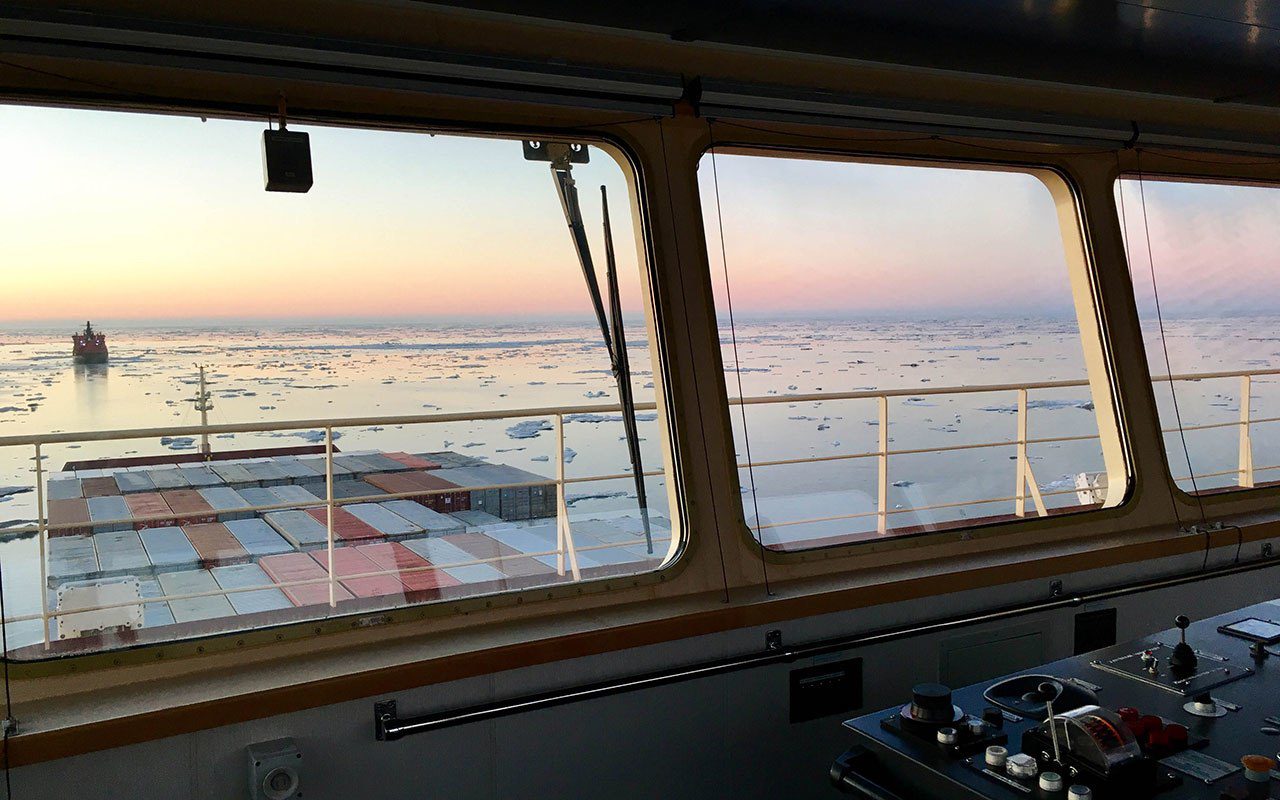
Two container ships from different countries are crossing the top of Russia this month, and neither is carrying Russian cargo. Sea Legend, a Singapore-incorporated line run from China, has launched a scheduled service from Ningbo to Felixstowe along the Northern Sea Route, offering eight departures and a twenty-day transit, about half the time of the Suez run it replaces.
Days behind, South Korea’s PanStar is sailing out of Busan on a trial voyage ordered by a president determined for his country to be first in line as the Arctic ice retreats, High North News reported on August 18.
For the first time since Western navies started counting, two foreign container operators are active on the route at once. The contradiction is laid bare in the numbers below them: High North News reported on August 18 that cargo on the Northern Sea Route rose fifteen percent in the first half of 2026 compared to a year earlier, and Moscow’s state nuclear-shipping company, which manages the icebreaker fleet, anticipates total volume will surpass forty million tonnes this year for the first time ever.
That record is being set under the heaviest sanctions ever applied to an Arctic economy.
The corridor that Washington and Brussels tried to freeze has become the one route where Russian traffic grows every single year, because the customer changed rather than disappeared. AP reported on August 14 that Rosatom and its chief, Alexey Likhachev, are pursuing Putin’s old vision of a northern artery along the Siberian coast, pulling investment into Russian ports and gas fields.
Beijing has sought what Xi Jinping, back in 2018, described as a polar silk road, and this year wants something still more urgent: energy that cannot be interdicted, after fighting around Hormuz froze Middle Eastern cargoes and China’s LNG imports from Russia shot up nearly twenty-eight percent by volume in the first half of the year, according to the same AP report.
Sea Legend’s CEO Li Xiaobin makes no secret of wanting freight revenue without geopolitical risk, stating the need for stable routes and no chokepoints, according to AP’s August 14 account. Washington wants to prevent this but has, so far, done little to change it.
A published timetable
The trigger this month is the liner schedule. Everything before was trial voyages: Maersk’s Venta Maersk in 2018, NewNew Shipping’s ad hoc runs, and the Istanbul Bridge’s record twenty-day transit in autumn 2025, as High North News noted on August 18. A published timetable with eight departures means insurance is being priced for repetition, terminals are expecting arrivals, and customers are booking space months ahead.
Sea Legend has also done something structurally new: its service calls at no Russian port, running from Ningbo to Felixstowe, Rotterdam, Hamburg, and Gdansk purely as a transit corridor, High North News reported on August 18. The slower pressure beneath is older than the war. Arctic Ocean ice cover has been retreating for four decades, lengthening each year’s navigation window, while Moscow has spent billions on nuclear icebreakers to extend that advantage. Meanwhile, the world’s other shortcuts have gotten riskier.
Red Sea attacks and the US-Iran conflict have stranded tankers and clogged Suez transits. Putin now calls the polar route the safest and most reliable of all, according to AP’s report from August 14. As alternative routes fail, this corridor starts to look like infrastructure.
Maersk never came back
Maersk’s 2018 voyage with the Venta Maersk ended with the conclusion that Arctic ice, limited ports, and small cargo capacity rendered the route commercially futile. The company never returned. That was the prevailing verdict for years. What has changed is that the Suez route now faces frequent disruptions, Chinese shipyards have built enough ice-class vessels to make the economics work, and Russia is set on selling transit to prove its relevance.
The counter-argument holds: Sea Legend’s vessels are far smaller than the megaships that drive ocean freight costs down, and even the optimists concede that the season lasts just a few months a year, as High North News clarified on August 18. In 2022, COSCO, China’s state giant, reached a similar conclusion and withdrew. It has not returned.
Sanctioned LNG moves fastest. Satellite imagery shows the Christophe de Margerie, fresh from calling at the US-sanctioned Arctic LNG 2 complex, delivering its cargo to the Koryak floating storage unit in Kamchatka before continuing east, with the Arctic Mulan repeating the maneuver days later and intermittently disabling its tracker, AP reported on August 14.
Sovcomflot, the state tanker operator excluded from Western finance, posted ninety-four million dollars in profit in the first quarter after a three-hundred-ninety-three-million-dollar loss a year ago, with revenue up sixty percent, according to High North News on August 18. Sanctions have concentrated the fleet rather than diminished it.
The West is now hardening its own stance. NATO’s Mark Rutte warned in July that Russian and Chinese access to the Arctic poses immense risk and requires coordination, Kaja Kallas named Chinese use of the corridor, and Washington negotiated a shipbuilding deal with Finland to grow an icebreaker fleet it currently lacks, all as reported by AP on August 14.
Insurers and coastal states will pay for the accidents this corridor will produce, since much of the growing traffic is older shadow-fleet tonnage running evasive patterns through waters that lack spill-response infrastructure, according to AP’s August 14 report. European importers will pay again if the EU’s scheduled ban on seaborne Russian LNG takes effect in 2027, as the same gas will continue arriving, simply rerouted and rebilled via intermediaries.
Profit flows as clearly to Rosatom, which collects transit fees and justification for its icebreaker budget, to Chinese carriers getting a cheaper Asia-Europe lane than their rivals, and to Novatek, which keeps loading at Sabetta regardless of Brussels’ moves.
If this analysis holds, Sea Legend will complete all eight departures without major incident or ice delay, PanStar will convert its trial to a scheduled run, and more operators will join next spring.
If the liners quietly skip sailings, if insurers sharply reprice Arctic coverage, or a hull is caught in early freeze-up with cargo aboard, the trial designation will have been justified.
Sanctions froze Western companies out of the Arctic and left the route to the only nation prepared to use it. A corridor sailed solely by an adversary’s partner is not a failed sanction: it is a transferred asset.