China's factories speed up while home shoppers stall, widening a demand gap
Faster output is leaning on export orders, leaving Chinese manufacturers exposed if overseas buyers pull back before households at home start spending more.
The National Bureau of Statistics reported on Sept. 15, 2026 that value added at China's larger industrial firms grew 5.2 percent in August from a year earlier, while retail sales of consumer goods rose just 0.4 percent.
Factories are producing faster, and the August figures suggest more of the buyers for the extra goods sit abroad rather than in Chinese homes. The split shows up in the jobs, price, investment and trade figures published over the past month. It leaves Chinese manufacturers leaning on customers they do not control: if foreign orders cool before households at home start spending, the added output has no obvious place to land.
Scroll across the figure. Full labels and values are below.
View figure data
| Item | Value |
|---|---|
| value added at China's larger industrial firms | 5.2 percent |
| retail sales of consumer goods | 0.4 percent |
| goods trade | 19.8 percent |
Demand at home barely moved from July. The National Bureau of Statistics reported on Sept. 15, 2026 that retail sales slipped 0.13 percent from the previous month, to 3,982.4 billion yuan, even as industrial value added rose 0.54 percent. The National Bureau of Statistics reported on Sept. 15, 2026 that output growth ran 0.7 percentage points faster than in July.
Jobs gave households no fresh reason to spend. The National Bureau of Statistics reported on Sept. 15, 2026 that the urban surveyed unemployment rate rose to 5.3 percent in August, 0.1 percentage points higher than the month before.
Consumer prices stayed soft. The National Bureau of Statistics reported on Sept. 10, 2026 that China's consumer price index rose 0.8% in August from a year earlier, with livestock meat prices down 5.1%, a drag of about 0.21 percentage points on the index.
Investment inside China is shrinking too. According to a Reuters story carried by Business Recorder, fixed-asset investment, the money spent on new buildings, plant and equipment, kept falling through the first eight months of the year, and the decline deepened from the period through July. That leaves less spending at home to absorb what factories make.
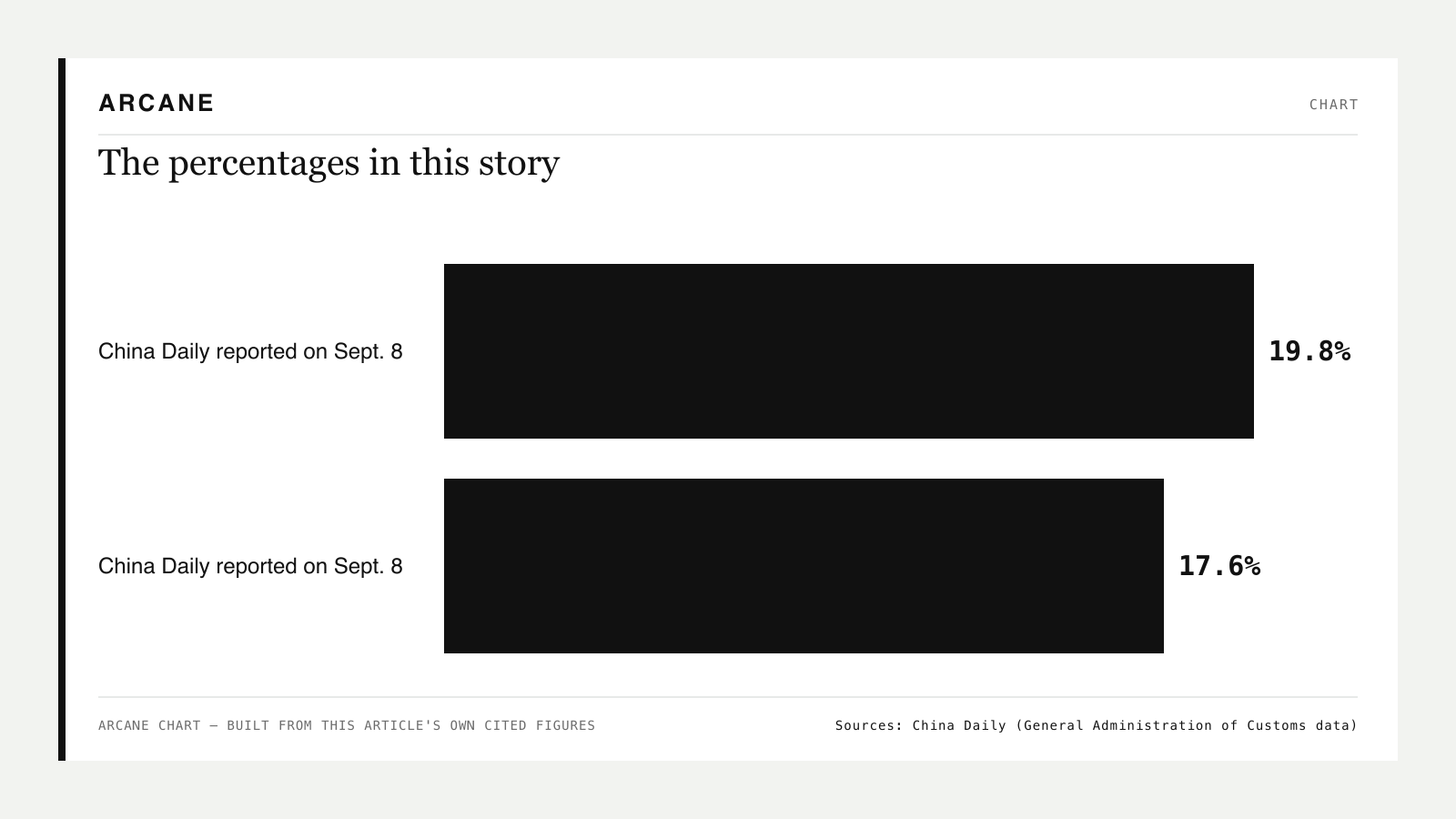
Trade tells a different story. China Daily reported on Sept. 8, 2026 that customs figures put China's goods trade at 4.65 trillion yuan in August, up 19.8 percent from a year earlier and above the 4-trillion-yuan mark for a sixth consecutive month. According to RSA Tax, the trade surplus widened in August from July.
WSAU reported on Aug. 31, 2026 that a private purchasing managers' index compiled by S&P Global, a monthly survey of factory buyers, rose to 51.5 in August from 50.9 in July, with new orders growing on the back of the sharpest rise in new export business in six months.
There is a case that demand at home is firming rather than fading. The State Council reported on Aug. 31, 2026 that the official factory survey's new orders index climbed to 50.6, up 2.1 percentage points from July, with the production index at 50.4.
Factory prices point the same way. The National Bureau of Statistics reported on Sept. 10, 2026 that producer prices for industrial products rose 3.8% in August from a year earlier. According to RSA Tax, imports also grew faster than exports.
Neither measure settles it. The official index does not show where its new orders came from, and the retail figure counts goods only. The National Bureau of Statistics reported on Aug. 28, 2026 that mining profits rose 34.9% from January to July, against 17.6% for industry overall, which suggests raw materials carry part of the price strength.
Exporters carry the gap. The household measures — retail sales, jobs and consumer prices — all lean the same way, while the stronger readings come from factories and their order books. Those household measures describe spending directly, which is why they deserve more weight here than a factory survey that counts customers at home and abroad together. Goods made faster than Chinese households buy them have to be sold somewhere, and the private survey shows where much of the new business came from.
Capacity is still being added. WSAU reported on Aug. 31, 2026 that output in the private survey rose at the fastest pace in three months, driven by stronger demand and capacity expansion. New production lines built against foreign orders cost money whether or not those orders last.
Profits have held up so far, which gives factories room to keep producing ahead of sales. The National Bureau of Statistics reported on Aug. 28, 2026 that profits at larger industrial firms reached 4,582.06 billion yuan from January to July, up 17.6% from a year earlier.
Costs are rising faster than selling prices. The National Bureau of Statistics reported on Sept. 10, 2026 that from January to August, the prices industrial producers paid for inputs rose 3.2% on average from a year earlier, against 2.0% for the prices they charged. That squeeze lands on the firms turning raw materials into finished goods.
China Daily reported on Sept. 8, 2026 that goods trade rose 17.6 percent in the first eight months of 2026, to 34.78 trillion yuan. If that flow cools, the first to feel it would be factories that added output for foreign buyers, and workers in a job market where unemployment is already edging up.
Until shoppers at home spend more, China's faster factories are leaning on orders from abroad. That is a narrower footing than the headline output figure suggests.